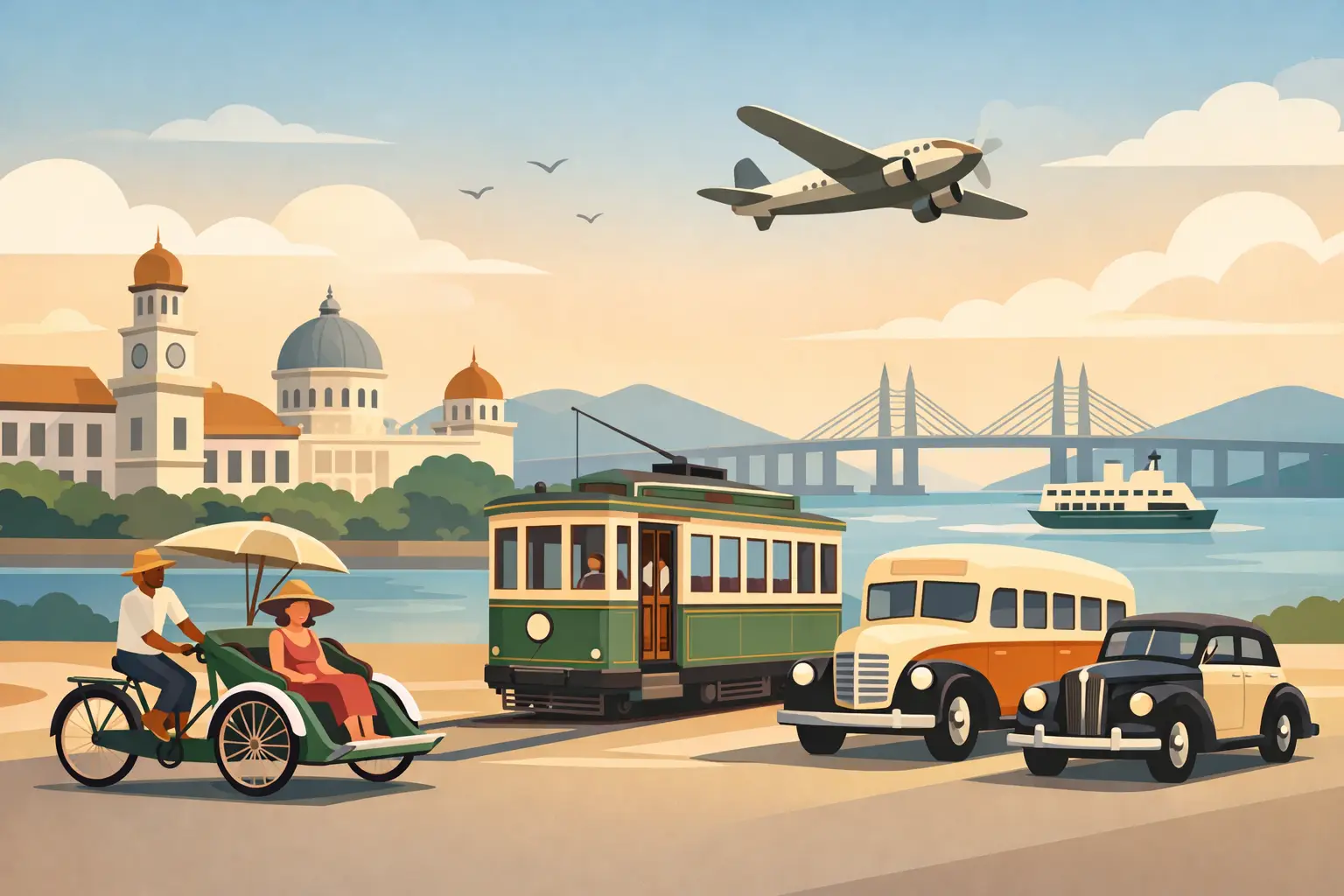
A ferry horn across the channel, the rattle of a trishaw wheel in George Town, the memory of a train line carrying tin, goods and people inland – old Penang transport history is not just about vehicles. It is about how a port city learned to move, how communities met one another, and how everyday journeys helped shape Penang’s identity.
For visitors, this history matters because Penang has never been a place where transport was merely functional. Movement here has always been tied to trade, migration, neighbourhood life and family memory. To understand Penang properly, it helps to understand how people crossed water, travelled streets and connected island to mainland long before modern roads made those trips feel ordinary.
Old Penang transport history begins at the water
Penang’s story starts with its harbour. As an island settlement with growing commercial importance, it depended on boats and ferries from the beginning. Before bridges and expressways changed expectations, the sea was not a barrier. It was the main route.
Small craft once carried passengers, labourers and goods between the island and the mainland. These crossings were practical, but they were also social spaces. Traders, dock workers, families and schoolchildren all shared the same channels. Maritime travel shaped the rhythm of daily life, and the waterfront became one of the island’s most important meeting points.
This is one reason Penang’s ferry story still feels personal. Ferries did more than transport passengers from one side to the other. They linked livelihoods, routines and relationships. A crossing could mean going to work, returning home, visiting relatives or reaching a market. That emotional layer is what makes transport history in Penang different from a dry timeline of machines and routes.
Ferries and the making of a shared Penang
When ferry services became more structured, they transformed mobility across the channel. Reliable crossings supported trade and made commuting easier. For many residents, the ferry became a familiar part of life, so ordinary that it almost disappeared into the background. Yet that is often the clearest sign of a transport system’s success – it becomes woven into routine.
The ferry’s importance also came from what it carried beyond passengers. Cars, bicycles, workers, stories, habits and expectations all moved with it. It helped bind island and mainland into a lived region rather than two separate places. In practical terms, this supported economic growth. In human terms, it made Penang feel connected.
There is a trade-off in how we remember this history. Large infrastructure projects often draw more attention because they look dramatic and signal progress. Ferries, by contrast, can be dismissed as old-fashioned once newer systems appear. But in Penang, the ferry is not a footnote to modernity. It is one of the strongest symbols of how the state functioned as a maritime community.
That is why stepping aboard a preserved vessel feels so different from reading a plaque on a wall. A real ferry still holds the scale, texture and atmosphere of those journeys. You can sense how movement across water shaped daily experience in a way that photographs alone rarely capture.
Streets in motion – trams, rickshaws and road traffic
Water transport may have defined Penang’s beginnings, but street travel gave shape to urban life. As George Town expanded, people needed ways to move between homes, shops, schools, offices and port areas. Over time, Penang’s streets hosted a mix of transport forms that reflected both colonial-era planning and local adaptation.
Trams once played a role in the urban transport picture, offering an organised mode of travel in a growing town. Their presence reflected a period when many port cities sought to modernise movement through fixed routes and public systems. But trams also had limits. They depended on infrastructure, maintenance and urban priorities that changed over time. As roads evolved and motor vehicles became more common, tram systems were harder to sustain.
Alongside these formal systems, human-powered transport remained central. Rickshaws, and later trishaws, became familiar features of Penang’s streetscape. They were practical in crowded urban areas and suited shorter journeys. More than that, they became part of the city’s visual identity. For residents, they were transport. For later generations, they also became a symbol of place.
That said, nostalgia can flatten the harder truths. A rickshaw is easy to romanticise in an old photograph, but it also speaks to labour, class and the physical demands placed on working people. Old transport history is richer when it includes that complexity. The same street that looked charming to some may have represented long hours and difficult work for others.
Rail, roads and the wider network
Penang’s transport story did not stop at the shoreline or city streets. Connections to the mainland rail system and expanding road networks widened the state’s economic reach. Goods could travel more efficiently inland, and passengers could link sea and land journeys in ways that supported trade throughout the region.
This mattered because Penang was never only a local town. It was part of a wider commercial network stretching across Malaya and beyond. Port facilities, roads and rail links all helped the island maintain its role as a place of exchange. Transport infrastructure, in that sense, was also economic infrastructure.
Still, not every new development replaced what came before in a neat line of progress. Different systems often overlapped. Boats, ferries, bicycles, motorcars, trishaws and trains each served different needs, budgets and distances. That mix is worth remembering because it reflects real life. People used what was available, affordable and reliable, not simply what appeared newest.
What old Penang transport history tells us about daily life
The most revealing part of old Penang transport history is how ordinary it was. Children travelled to school. Workers crossed the channel before sunrise. Families carried market goods home. Visitors arrived with first impressions shaped by a jetty, a road, a station or a ferry deck.
Transport also influenced where communities settled and how businesses grew. Areas with easier access became busier. Waterfront spaces developed their own routines. Streets with steady traffic supported shops, coffee houses and services. In this way, mobility quietly influenced the social geography of Penang.
For heritage travellers, this is where transport history becomes especially rewarding. It is not separate from food history, migration history or urban history. It touches all of them. The route someone took to work affected where they ate breakfast. The harbour they landed at affected where they rented a room. The ferry they boarded affected who they met and how they understood the island.
Why this history still matters to visitors now
Many historic transport systems disappear so completely that they can only be imagined. Penang is fortunate that some of its maritime memory can still be felt in a more direct way. That matters because heritage is strongest when it is experienced, not only described.
For families, transport history offers an accessible way into the past. Children immediately understand the idea of a journey. For school groups, it turns abstract lessons about trade, colonialism and urban growth into something tangible. For travellers, it gives Penang depth beyond its postcard landmarks.
It also encourages a more thoughtful kind of tourism. Instead of racing from one attraction to another, visitors can pause and ask how the place worked, who moved through it, and what made daily life possible. A ferry deck, a roadside trishaw, or an old harbour view can open that conversation in a surprisingly powerful way.
This is part of why places such as the Penang Ferry Museum resonate. They do not present transport as a technical subject alone. They invite people to step into a piece of Penang’s history and feel the lived reality of crossing, waiting, arriving and returning.
A living heritage, not a finished chapter
Penang’s transport story is still evolving. Modern systems answer modern needs, and no city can stand still for the sake of nostalgia. Yet preserving older forms of transport memory remains worthwhile because they explain how Penang became Penang.
The ferry, in particular, reminds us that infrastructure can carry feeling as well as function. It can hold memory, belonging and civic pride. When people remember old crossings, they are often remembering more than a route. They are remembering a version of the city and of themselves within it.
That is the enduring value of old Penang transport history. It shows that movement is never only about getting from one place to another. In Penang, every crossing has helped make the place what it is – and that is a journey still worth boarding.
Leave a Reply