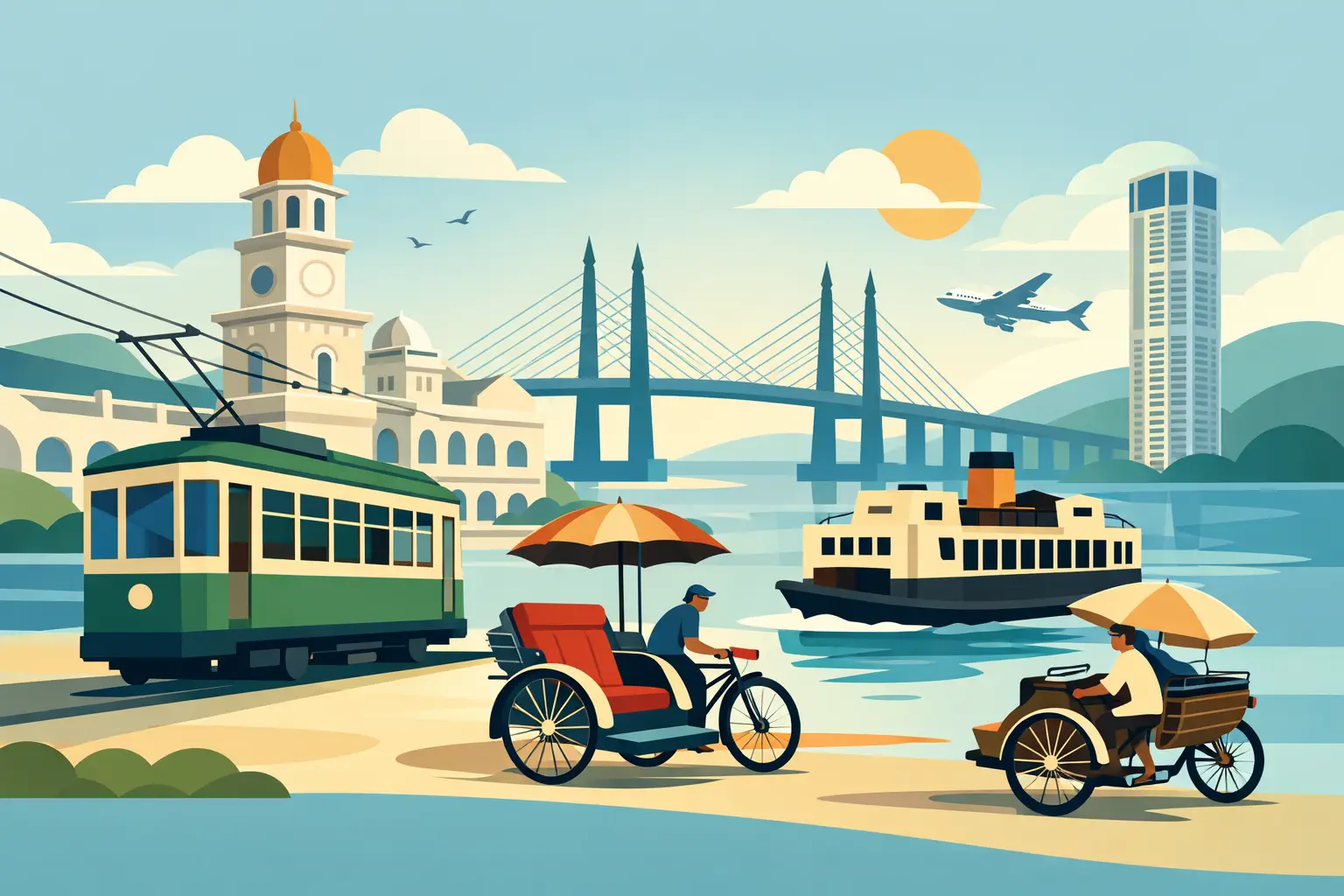
The quickest way to understand Penang is not to start with a monument, but with a journey. Stand by the water, watch the ferries, listen for the traffic threading through George Town, and this guide to Penang transport heritage begins to make sense at once. Here, movement is memory. The way people crossed the channel, carried goods, went to school, visited family, or arrived in search of work helped shape the island’s identity just as surely as its buildings and streets did.
Why Penang transport heritage matters
Transport history can sound technical until you place it in everyday life. In Penang, it is deeply human. Ferries were not simply vessels linking two points on a map. They were part of daily routine, reunion, work, and ritual. Roads and rail connections changed how neighbourhoods grew, how trade moved, and how communities met each other.
That is why Penang’s transport heritage deserves more than a passing glance. It tells the story of a port city that grew through connection. Maritime routes brought people, languages, foodways, and business. Local transport then stitched these arrivals into the rhythms of island life. When visitors look at an old ferry, a trishaw, or a historic station site, they are not only looking at machinery or infrastructure. They are seeing how Penang learned to move together.
For families and cultural travellers, this makes transport heritage especially rewarding. It gives children something concrete to imagine – the sound of engines, the feel of a deck underfoot, the bustle of a crossing. For history enthusiasts, it offers a richer frame for understanding George Town beyond its facades.
A guide to Penang transport heritage through its ferry story
If there is one place to begin, it is with the ferry. Penang’s maritime identity has always been central to its story, and the ferry service became one of its most recognisable public experiences. For generations, crossing the water was practical and emotional at the same time. It connected the island and mainland, but it also connected routines, families, and memories.
There is a particular quality to ferry heritage that makes it different from reading transport history on a wall panel. A ferry is built for shared passage. People do not experience it in isolation. They board, wait, look outward, and arrive together. That collective dimension is part of what gives Penang’s ferry legacy such lasting affection.
For visitors, the value lies in seeing this history as lived experience rather than a closed chapter. Stepping aboard a preserved vessel offers something photographs alone cannot. You notice the proportions of the decks, the practical design of the spaces, and the atmosphere of travel that once felt entirely ordinary. That ordinariness matters. Heritage is not only about grand occasions. Often it survives most strongly in the things people used every day.
One especially meaningful stop is Penang Ferry Museum, where visitors can step into a piece of Penang’s history aboard an authentic historic ferry. It offers a rare chance to experience maritime heritage in the place where that story naturally belongs – on the vessel itself, not separated from it.
Beyond the ferry: streets, wheels, and working movement
A proper guide to Penang transport heritage should not stop at the waterfront. Once people arrived, they still needed to move through town, trade, and neighbourhoods. This is where Penang’s street transport story becomes just as revealing.
Trishaws remain one of the most recognisable heritage images in George Town. For some visitors, they are charming symbols of an older city. Yet they were also working transport. They carried passengers, goods, and stories through narrow streets long before heritage tourism gave them a second life. Looking at them only as quaint objects misses their social role. They belonged to a living urban economy.
Motor vehicles then changed the pace and scale of movement. Buses, taxis, private cars, and commercial transport altered how people planned their days and how the city expanded. This is where heritage becomes slightly more complicated. Not every newer form of transport feels nostalgic, and not every change was welcomed. Faster movement often brought convenience, but it could also reduce the intimacy of older travel patterns. A ferry crossing or trishaw ride asks for patience. Modern transport usually does not.
That tension is worth noticing. Heritage is not about pretending the past was easier or better in every respect. It is about understanding what was gained and what was left behind.
The railway thread in Penang’s wider story
Railway history also belongs in any thoughtful account of transport heritage in the region, even if many visitors know less about it than the ferries. Penang’s role as a trading and port hub meant that links beyond the island mattered enormously. Rail networks helped move tin, rubber, produce, and passengers across the peninsula, feeding the commercial life that flowed through Penang’s port and markets.
This wider transport web matters because Penang was never an isolated island story. Its strength came from being connected – by sea, by road, and by rail – to larger economic and cultural routes. For heritage-minded travellers, that means transport history should be read as a network rather than a set of separate attractions.
If you enjoy piecing together how places functioned, this broader perspective makes a visit far more rewarding. The ferry tells one part of the story, but the docks, roads, warehouses, and stations all belong to the same conversation about movement and exchange.
How to experience Penang transport heritage well
The best approach is to slow down. Penang rewards visitors who pay attention to transitions – shoreline to street, jetty to road, old civic core to working harbour. Rather than rushing from one landmark to the next, notice how the city still carries traces of transport history in ordinary views.
Start with the waterfront if you can. It gives you the clearest sense of Penang as a place shaped by arrival and departure. Then continue into George Town with an eye for how movement shaped urban life. Street widths, shopfronts, transport nodes, and older public buildings all make more sense once you think about how people and goods circulated through them.
For families, an experience-led stop is often more memorable than a purely text-heavy one. Children tend to understand heritage best when they can stand inside it, look around, and imagine who once used the space. Adults often respond in much the same way, even if they call it nostalgia instead of learning.
It also helps to accept that transport heritage is not always polished. Some parts are beautifully preserved, while others survive in fragments, local memory, or changing urban landscapes. That is not a flaw. In many ways, it reflects Penang honestly. This is a place where history remains active, layered, and sometimes uneven.
What transport heritage reveals about local identity
Penang’s transport story is, at heart, a story about connection across differences. Port cities gather people from many backgrounds, and transport systems are the everyday structures that allow those communities to function together. A ferry deck, a roadside stop, a trishaw route – these are practical spaces, but they are also shared civic spaces.
That is part of why transport heritage still resonates so strongly with local pride. People remember crossings with parents and grandparents. They remember routines that seemed ordinary then and precious now. Visitors may arrive seeking history, but what they often find is something more personal: evidence of how a place held its community together.
This is also why authenticity matters. A recreated display can be informative, but an original vessel or historic setting carries a different weight. It has witnessed the very journeys being interpreted. That closeness between story and setting gives heritage real emotional force.
Making space for both nostalgia and change
There is no honest way to discuss heritage without acknowledging change. Penang cannot and should not remain frozen in one era. Residents need efficient, practical transport for contemporary life. At the same time, progress does not require forgetting the systems and experiences that shaped the island.
The best heritage work makes room for both realities. It preserves what can still be felt and understood, while recognising that today’s city has different needs. For visitors, this balance is part of the appeal. Penang is not a staged backdrop. It is a living place where old transport stories still sit alongside present-day movement.
That makes a heritage visit more than a look backward. It becomes a way of seeing Penang more clearly in the present. The ferries, streets, and routes of the past continue to explain why the island feels the way it does now.
If you are planning your time in George Town, let transport history shape at least part of your journey. It offers one of the clearest, warmest ways to understand the island – not only where people went, but how they belonged to one another while getting there.
Leave a Reply